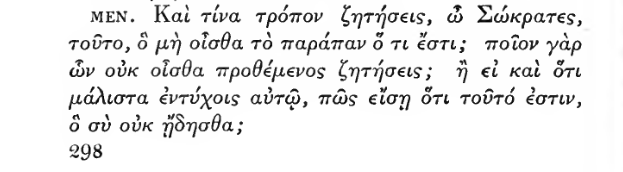
MEN: O Socrates, [how] are we even examining somebody’s character if you do not learn [it] alongside all that is? Before the land1 [how] are we investigating that which you do not know?
Who if even most of all [is] in the fortunes of men2 of itself, if they are in a certain way, here is he, had you not known? (80d5-8)
In Joycean fashion, Heidegger investigates the essence of technology means of the phenomenological stream-of-consciousness method of philosophical investigation. Imagine a stone, sourced in anonymous channels from a quarry in a working-class town of laborers. Once polished, and sanded down, ready-to-use in multifarious means as garnishing, it becomes a tool. It serves not only as an end, but a genuine activity germinates in an experimental insertion within its sphere of development. Consider the radar station, in some remote corner of the Urals, and an inter-species effort towards the “construction of a high-frequency apparatus [that] requires an interlocking of various processes of technical-industrial production.” Hediegger refers to this interlocking as its gestell, a synthetic confluence Aristotelian causa. As matter and form begin to speciate in hylomorphicunification, its dissociation is disclosed in the essence of technology. Its aition, or cause is unveiled in the intricate columnar schematics of a sacrificial chalice. Hephaestus, hobbling and winged-footed smith of Zeus, crafts its form bound by the confines of unadulterated silver. Mastery over the medium, prospected by slaves castrated on a whim by tyrants contracted by hydraulic mining firms in French Afrique, is embodied in its source. Lying inert in its pre-capitalized form, silver already implicitly contains the form of a sacrificial chalice in its anatomic structure. Only upon its seizing, can its telos, the “fortunes of men” be enumerated in a joint-stock venture and scrawled in neolithic script upon V-6 engine blocks.
1προθεμενοσ is a conjunct of προσ, meaning before or prior to, and τέμενες: a portion of land designated for divine use or in the official domain.
2εντυχοις is a conjunct of εν, meaning in, and the genitive of τύχης,referring to fortune or chance.
 Recollection Services Incorporated
Leave a comment