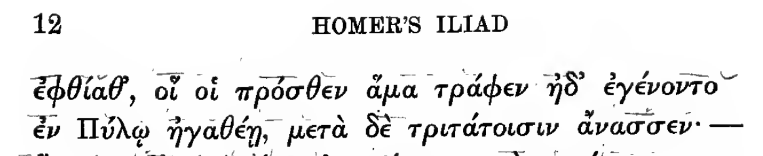
“…who when found in a place, she nursed its being coming into existence in the sacred gate of the sun, with the third part to be chief.”
The phrasing is a bit ambiguous here, but that which comes into existence requires further exposition. The word employed by Homer is “ἐγένοντο,” which is the aorist aspect of the original verb “γίγνομαι.” Typically parsed as a coming into, either as being born, or coming into existence. This implies a being that receives the action, given that a concept, its formal projection requires that it exist. Ideas, formative concepts, even the synthetic a-priori is predicated on there being a being. Thus, “γίγνομαι,” the being born, an idea coming into existence, is closely tied to the knowing and being familiar with the concept. Thus, the “γιγνώσκω,” – “I know,” forming an understanding is prior to the “γίγνομαι.”
One more postscript on the society of understanding. In thought, before a formal concept can come into existence, the “γιγνώσκω,” as eternally vying with the “γίγνομαι,” namely that knowing being is at odds with being itself, that which comes into existence. It may be that thought is the containment of being itself. The “γιγνώσκω,” factor X is precisely what the ancient metaphysicians were concerned with. That which is, comes into being, implies a being. An un-moved mover.
 Recollection Services Incorporated
Leave a comment